
What is the Lanna Kingdom?
The land of a Million Rice Fields
The Lanna Kingdom was a powerful Tai-Yuan polity that controlled most of what is now Northern Thailand, Eastern Myanmar (Shan State), and parts of Laos and Southern China between the 13th and 18th centuries. The term "Lanna" (ล้านนา) literally translates to "Million Rice Fields," a name that signifies food security, logistical capacity, and the ability to sustain large armies and urban populations.
In modern usage, "Lanna" refers to both the historical period and the enduring cultural identity of the eight upper northern provinces of Thailand: Chiang Mai, Chiang Rai, Lamphun, Lampang, Phrae, Nan, Phayao, and Mae Hong Son. Unlike the central Thai kingdoms of Sukhothai or Ayutthaya, which relied on vast river plains, Lanna was a civilization of the valleys. It developed in the intermontane basins of the Ping, Wang, Yom, and Nan rivers, separated by rugged mountain ranges that allowed distinct sub-cultures to flourish while maintaining political unity through allegiance to Chiang Mai.
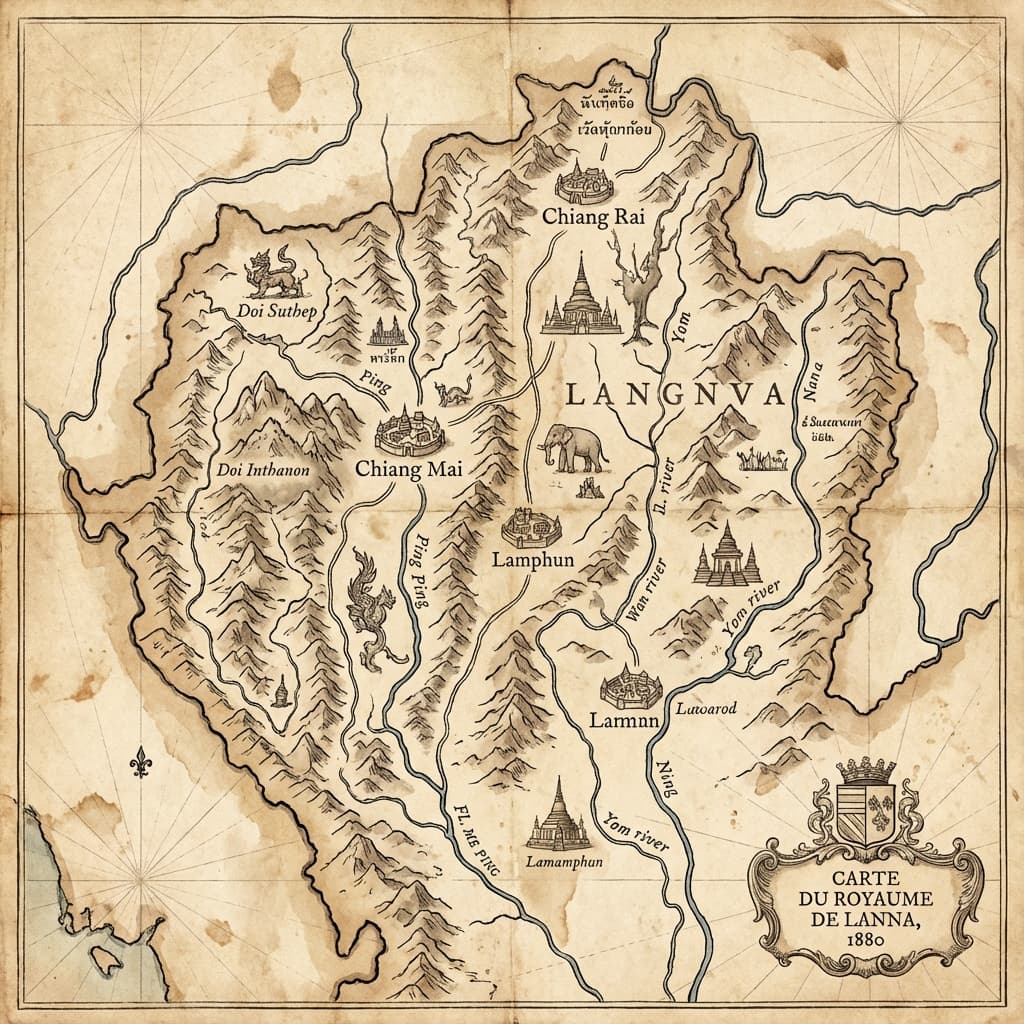
The Mandala State: Power Without Borders
To understand Lanna, one must discard the modern concept of nation-states with fixed borders. Lanna operated as a Mandala state. In this geopolitical model, power radiated from a center (Chiang Mai) and faded with distance. Sovereignty was defined by relationships of tribute and loyalty rather than territorial lines on a map.
- The Center: The King in Chiang Mai held absolute spiritual and temporal authority at the core.
- The Tributaries: Outlying cities like Nan or Phrae were semi-autonomous. They paid tribute (often in the form of gold and silver trees, or bunga mas) and provided troops during war, but retained their own local rulers and laws.
- The Overlapping Margins: Border areas often paid tribute to multiple overlords simultaneously—perhaps sending gifts to both Chiang Mai and Ayutthaya (or Burma) to ensure safety. This fluidity allowed Lanna to survive for centuries amidst aggressive neighbors.
Lanna vs. Chiang Mai: Clarifying the Confusion
"Lanna" and "Chiang Mai" are frequently used interchangeably in travel literature, but they are distinct concepts.
- Chiang Mai is the city—the "New City" founded in 1296 to serve as the capital. It is the physical stage where the drama of the kingdom played out.
- Lanna is the civilization—the broader cultural, linguistic, and political entity.
While Chiang Mai contains the most famous monuments, the Lanna spirit is equally present in the teak mansions of Phrae, the temple murals of Nan, and the weaving villages of Lamphun. This website treats Lanna as a regional ecosystem, where the capital cannot be understood without its network of supporting cities.