
Places Across Northern Thailand
The eight provinces of the Lanna heartland
Chiang Mai: The Rose of the North
As the capital founded in 1296, Chiang Mai is the primary repository of Lanna heritage. Its Old City, a square mile surrounded by moats, contains the highest density of wats. It serves as the gateway for exploring the rest of the region.
Chiang Rai: The First Capital
Founded by King Mangrai in 1262 (before Chiang Mai), Chiang Rai was the first capital of the Mangrai dynasty.
- Significance: It is the home of the Emerald Buddha (discovered at Wat Phra Kaew in 1434 when lightning struck a chedi, revealing the jade image inside). Today, it is known for its contemporary temple architecture, such as the White Temple (Wat Rong Khun) by Chalermchai Kositpipat, which reinterprets Lanna art for the modern era with surrealist and pop-culture elements.
Lamphun: The Ancient Mon Root
Lamphun is older than Lanna itself. Originally the Mon kingdom of Hariphunchai, it was conquered by Mangrai in 1281.
- Heritage: Lamphun retains a unique city plan shaped like a conch shell. It is home to Wat Phra That Hariphunchai, a masterpiece of Mon-Lanna fusion featuring a golden chedi that serves as the prototype for many northern stupas. It is the spiritual ancestor of the northern cities.
Lampang: The Teak City
Lampang flourished in the late 19th and early 20th centuries as the center of the international teak trade.
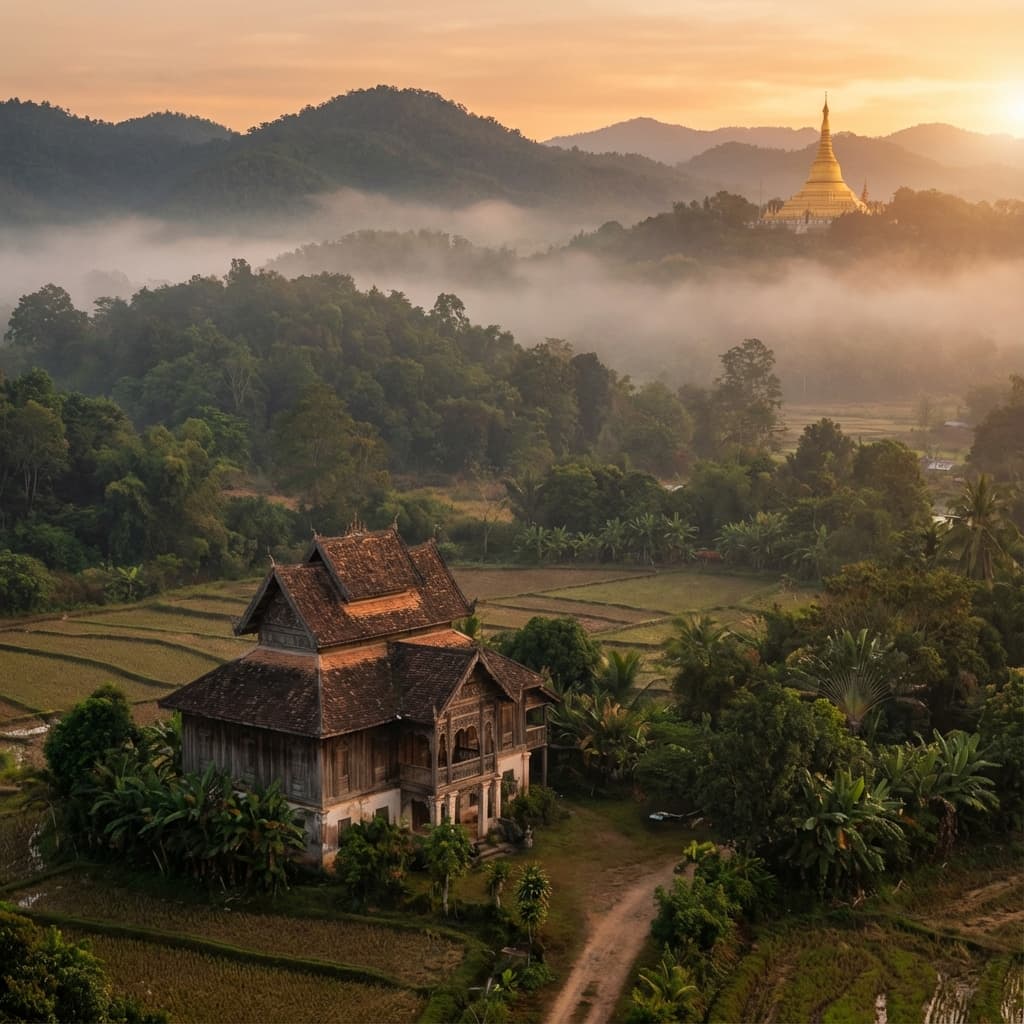
- Architecture: The city is famous for its "Gingerbread" houses and Burmese-style temples (like Wat Sri Rong Muang) built by wealthy Burmese teak merchants who worked for British logging firms. It is also the only city in Thailand where horse-drawn carriages are still used as transportation, a legacy of this prosperous era.
- Wat Phra That Lampang Luang: Located just outside the city, this is arguably the most perfectly preserved Lanna temple fortification. It features an open-sided wooden viharn that dates back to the 15th century, surrounded by ancient walls.
Phrae: Teak and Legends
Phrae is a hidden gem known for its massive teak forests and the "Gingerbread" teak mansions of the Vongburi House and Khum Chao Luang, built by the last Lords of Phrae. Its traditional crafts include indigo dyeing and woodwork.
- The Bomb Legend: Phrae is famously associated with the "Phrae Exploded Bomb" legend. During WWII, unexploded Allied bombs were found by locals. Instead of fearing them, the locals defused them and turned the metal casings into temple bells, symbolizing the Lanna ability to transform danger into merit. These bells can be seen at Wat Phra That Cho Hae.
Nan: The Remote Kingdom
Isolated by mountains, Nan remained semi-autonomous until the 1930s.
- Culture: Nan has a distinct Tai Lue influence. Its most famous mural, "The Whisperer of Love" at Wat Phumin, depicts a tattooed man whispering to a woman, capturing the intimacy and humor of Lanna life. The province offers a more pristine, quiet version of Lanna culture compared to the bustle of Chiang Mai.
Mae Hong Son: The Shan Frontier
Bordering Myanmar, Mae Hong Son is culturally Shan (Tai Yai).
- Landscape: Known as the "City of Three Mists," its temples (like Wat Phra That Doi Kong Mu) feature Burmese-style stupas and multi-tiered metal roofs, reflecting its distinct ethnic history and isolation from the central Thai plains.