
History of the Lanna Kingdom
From King Mangrai to modern Thailand
Founding Chiang Mai: The Vision of King Mangrai (1296)
The history of Lanna as a unified state begins with King Mangrai (1239–1311). Originally the ruler of Ngoenyang (near modern Chiang Saen), Mangrai was a brilliant strategist who recognized that the small Tai principalities needed to unite to survive Mongol expansion from China.
The city was designed as a rectangular fortress surrounded by moats and walls, a layout that symbolized a human body and adhered to cosmological beliefs to ensure prosperity. This act of state-building transformed a loose collection of tribes into a centralized kingdom. The selection of the site was reportedly influenced by auspicious omens, including the sighting of a white sambar deer and a white mouse family, which were interpreted as signs of the location's protective spirits.
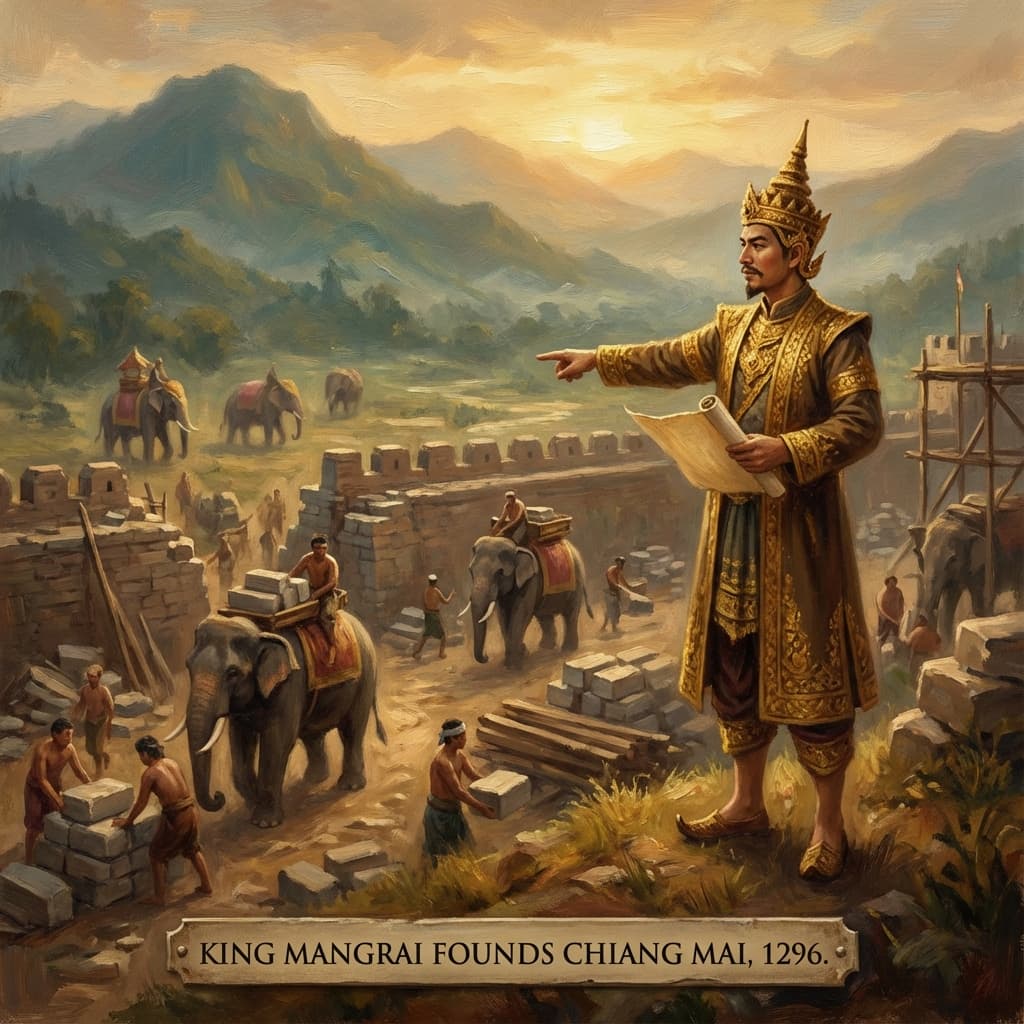
The city was designed as a rectangular fortress surrounded by moats and walls, a layout that symbolized a human body and adhered to cosmological beliefs to ensure prosperity. This act of state-building transformed a loose collection of tribes into a centralized kingdom. The selection of the site was reportedly influenced by auspicious omens, including the sighting of a white sambar deer and a white mouse family, which were interpreted as signs of the location's protective spirits.
The Golden Age: Buddhism and Scholarship under King Tilokarat
Lanna reached its zenith in the 15th century under King Tilokarat (r. 1441–1487). This period is often described as the "Golden Age" of Lanna literature and religion. Tilokarat was a fervent patron of Theravada Buddhism. He sponsored the Eighth World Buddhist Council in 1477 at Wat Chedi Luang to revise the Pali Tripitaka scriptures, establishing Chiang Mai as a global center of Buddhist scholarship.
During this era, the kingdom expanded its territory towards the Shan States and fought a series of inconclusive wars with the Ayutthaya Kingdom to the south. The arts flourished, with the creation of the distinct "Lanna" style of Buddha images (the Lion Lord style) and the construction of massive stupas that still dot the landscape today. It was during this time that the Emerald Buddha, Thailand's most sacred image, was housed in the great chedi of Wat Chedi Luang before being moved to Luang Prabang and eventually Bangkok.
The Burmese Conquest (1558) and the "Dark Age"
Following a succession crisis and internal disunity, Lanna weakened. In 1558, the kingdom fell to the expanding Toungoo Empire of Burma (Myanmar) under King Bayinnaung. This marked the beginning of over two centuries of Burmese suzerainty.
Chiang Mai became a forward operating base for Burmese campaigns against Ayutthaya. While Thai historiography often paints this as a "Dark Age," recent scholarship suggests it was a complex period of cultural exchange. Burmese influence seeped into Lanna legal codes, dress, and architecture (visible today in the "Burmese-style" temples of Lampang and Mae Hong Son). However, heavy taxation and conscription eventually depopulated the region, leaving Chiang Mai largely abandoned and overgrown with jungle by the late 18th century.
The Revival and Integration into Siam
The resurrection of Lanna began in 1774, when local noble Kawila of Lampang joined forces with King Taksin of Thonburi to drive out the Burmese. This began the era of the "Chao Chet Ton" (Seven Princes) dynasty. Kawila, operating as a tributary to the new Siamese capital in Bangkok, repopulated Chiang Mai by forcibly relocating people from the Shan states and Yunnan (a policy known as "Put Vegetables in the Basket, Put People in the City"). This repopulation strategy explains the diverse ethnic tapestry of modern Northern Thailand, as entire villages of Tai Khoen, Tai Yong, and Tai Lue were moved into the valleys surrounding Chiang Mai and Lamphun.
The final chapter of Lanna as a semi-independent kingdom occurred under King Chulalongkorn (Rama V) in the late 19th century. Facing colonial pressure from Britain (which controlled Burma) and France (Indochina), Rama V launched the Thesaphiban reforms. These reforms replaced local lords with centrally appointed governors and integrated Lanna into the Siamese state as Monthon Phayap (Northwestern Circle) in 1899. The Lanna royalty were stripped of their administrative power but retained their symbolic status, completing the transformation of the Lanna Kingdom into Northern Thailand.